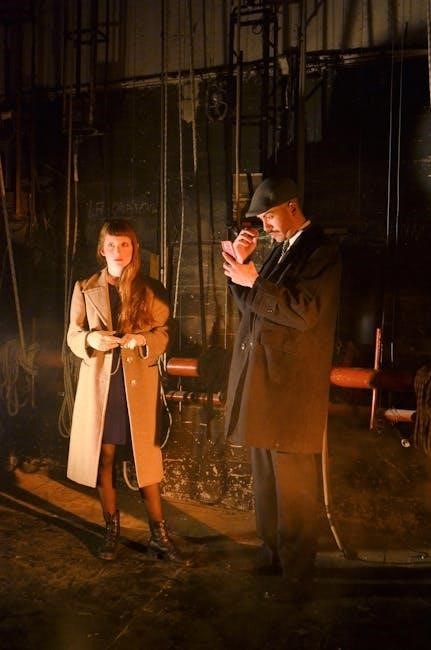
An Inspector Calls Play PDF: A Comprehensive Guide
Finding a reliable ‘An Inspector Calls’ play PDF requires careful searching, as quality varies greatly online. Numerous websites offer digital copies,
often aligning with AQA English Literature specifications and assessment criteria.
Accessing these PDFs can aid revision, providing a readily available text for study and analysis, particularly useful for exam preparation and critical essay writing.
Understanding the Play’s Context

To fully grasp J.B. Priestley’s ‘An Inspector Calls’, understanding its immediate pre-war context is crucial. The play, set in 1912, deliberately foreshadows the societal upheaval of World War I, a cataclysm that shattered Edwardian complacency. Priestley utilizes this setting to critique the prevailing social order and expose the vast inequalities inherent within it.
The availability of an ‘An Inspector Calls’ play PDF facilitates close textual study, allowing readers to pinpoint Priestley’s subtle yet powerful commentary on class divisions and the responsibilities of the wealthy. The play’s dramatic structure, unfolding over a single evening, intensifies the scrutiny of the Birling family’s actions and their impact on Eva Smith.
Examining the play within its historical framework—a time of burgeoning socialist thought and growing labor unrest—reveals Priestley’s deliberate intention to advocate for social justice and collective responsibility. A digital PDF version allows for easy annotation and cross-referencing, enhancing comprehension of these complex themes.
The Author: J.B. Priestley and His Socialist Views
J;B. Priestley, a prominent mid-20th century playwright, was a committed socialist whose beliefs profoundly shaped ‘An Inspector Calls’. His experiences during both World Wars fueled his conviction that societal change was essential, advocating for collective responsibility and social justice. Accessing an ‘An Inspector Calls’ play PDF allows for focused analysis of how these views permeate the text.
Priestley believed in the power of theatre to provoke thought and challenge established norms. The play serves as a direct expression of his socialist ideals, critiquing the capitalist mindset embodied by Arthur Birling. A digital copy facilitates detailed examination of Priestley’s dramatic techniques, such as dramatic irony and symbolism.
Understanding Priestley’s political leanings is vital for interpreting the play’s message. The Inspector’s role as a moral compass, and the tragic fate of Eva Smith, are direct reflections of Priestley’s concern for the vulnerable and exploited. Studying the play via PDF enhances understanding of his authorial intent.
Historical Background: Britain in 1912
‘An Inspector Calls’ is deliberately set in 1912, a pivotal year on the cusp of significant societal upheaval. Britain was experiencing vast class disparities, with a privileged upper class and a struggling working class – a context readily explored when studying an ‘An Inspector Calls’ play PDF. This era preceded the First World War, a conflict that would shatter Edwardian complacency.
The play reflects the pre-war optimism of the Birlings, contrasted with the looming threat of social unrest and war. Access to a digital text allows for close reading of dialogue revealing the prevailing attitudes towards class, gender, and responsibility. The Labour Party was gaining momentum, challenging the established political order.
Priestley used this historical setting to highlight the injustices of the time and to warn against the dangers of unchecked capitalism. Examining the play’s context through a PDF version deepens comprehension of its social and political commentary, revealing its enduring relevance.
The Play’s Structure: A Three-Act Drama
‘An Inspector Calls’ employs a tightly structured three-act format, crucial to Priestley’s dramatic intent. Each act progressively reveals information about Eva Smith’s connections to the Birling family, building suspense and intensifying the moral scrutiny. Studying an ‘An Inspector Calls’ play PDF facilitates tracing this structural development.
Act One introduces the characters and the initial investigation, establishing the Birlings’ comfortable, self-assured world. Act Two unravels the individual roles each family member played in Eva’s downfall. The final act delivers the shocking revelation and the Inspector’s powerful warning.
This structure isn’t merely chronological; it’s designed to force a collective examination of conscience. A PDF allows for easy annotation and comparison of scenes, highlighting Priestley’s deliberate pacing and dramatic irony, ultimately reinforcing the play’s central themes.

Character Analysis
Detailed character studies, easily accessible within an ‘An Inspector Calls’ play PDF, reveal Priestley’s masterful portrayal of societal flaws and individual responsibility.
Arthur Birling: The Archetypal Capitalist
Within an ‘An Inspector Calls’ play PDF, Arthur Birling emerges as the embodiment of Edwardian capitalist values – self-importance, social climbing, and a staunch belief in individual responsibility. He represents the established order, prioritizing profit and reputation above all else.
Birling’s pronouncements on the inevitability of peace and the unsinkability of the Titanic, swiftly proven wrong, highlight Priestley’s dramatic irony and critique of upper-class arrogance. The PDF allows close examination of his dismissive attitude towards Eva Smith, revealing a callous disregard for those less fortunate.
His attempts to shield his family from scandal, particularly concerning Eric’s theft from the company, demonstrate a prioritization of social standing over genuine remorse. Analyzing Birling through the play PDF reveals a man deeply flawed, representing the societal ills Priestley aimed to expose.
Sybil Birling: Social Responsibility and Hypocrisy

Examining Sybil Birling within an ‘An Inspector Calls’ play PDF reveals a character deeply entrenched in societal expectations and rigid moral codes. She represents the philanthropic facade of the upper class, publicly advocating for charity while privately demonstrating a lack of genuine compassion.
The PDF highlights her staunch defense of her social position and her unwavering belief in the deserving versus undeserving poor. Her involvement with the Brumley Women’s Charity Organisation is presented as performative, masking a judgmental attitude towards those seeking help, like Eva Smith/Daisy Renton.
Sybil’s ultimate hypocrisy lies in unknowingly condemning her own grandson, Eric, for his role in Eva’s downfall. Analyzing her dialogue within the play PDF exposes a woman blinded by privilege and unwilling to acknowledge her own complicity in social injustice.
Sheila Birling: Transformation and Moral Awakening
A close reading of Sheila Birling through an ‘An Inspector Calls’ play PDF demonstrates a significant character arc, evolving from a somewhat superficial and self-absorbed young woman to one capable of genuine empathy and moral reflection.
Initially, the PDF reveals Sheila’s delight in using her social status to exert power, as seen in her role in getting Eva Smith dismissed from Milwards. However, as the Inspector’s investigation unfolds, she begins to understand the consequences of her actions and the interconnectedness of society.
Unlike her parents, Sheila accepts responsibility for her part in Eva’s tragedy and expresses remorse. The play PDF showcases her growing awareness of social injustice and her rejection of her family’s callous attitudes, marking a powerful moral awakening.

Eric Birling: Guilt, Alcoholism, and Social Injustice

Examining Eric Birling via an ‘An Inspector Calls’ play PDF reveals a character burdened by guilt and struggling with alcoholism, stemming from his complicity in Eva Smith’s fate and a dysfunctional family dynamic.
The PDF highlights Eric’s theft of money from his father’s business to support Eva, demonstrating a conflicted morality – he recognizes the injustice she faces but resorts to dishonest means to help. His drinking is presented as a coping mechanism for his internal turmoil and dissatisfaction.
Unlike his parents, Eric acknowledges a degree of collective responsibility, criticizing their self-righteousness. The play PDF illustrates his frustration with his father’s authoritarianism and his desire for genuine connection, ultimately revealing a character trapped by societal expectations and personal demons.
Inspector Goole: The Moral Compass and Catalyst
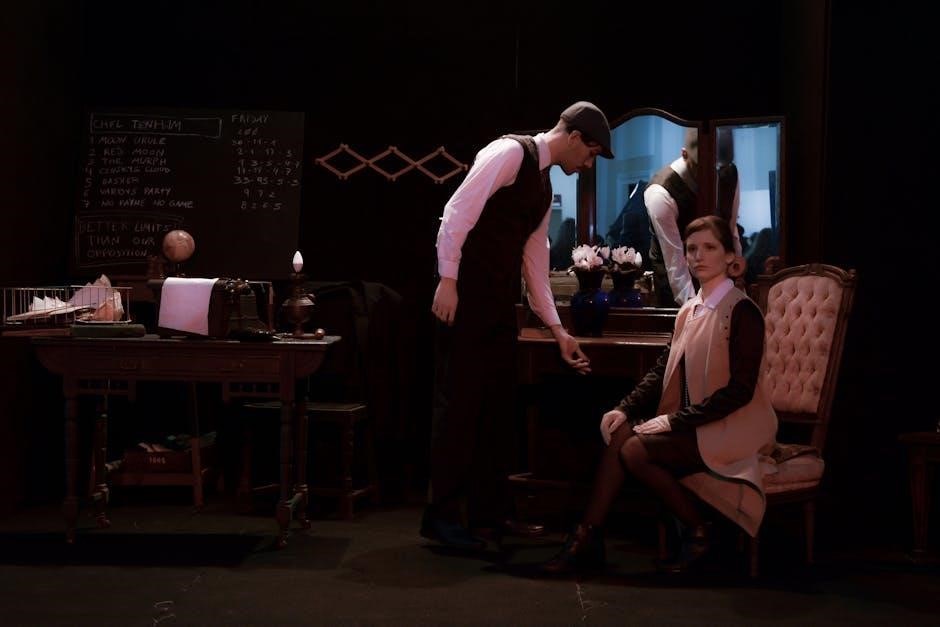
Analyzing Inspector Goole through an ‘An Inspector Calls’ play PDF reveals him as a pivotal figure, functioning as both a moral compass and a catalyst for the Birling family’s self-examination.
The PDF demonstrates his deliberate, probing questioning style, designed to expose the interconnectedness of their actions and their devastating consequences for Eva Smith. He isn’t a traditional detective seeking facts, but rather an agent of social conscience.
His ambiguous nature – his name, his lack of a conventional police presence – fuels speculation about his true identity, potentially representing a higher authority or even a collective societal judgment. The play PDF emphasizes his final speech, a powerful warning about collective responsibility and the dangers of complacency.
Eva Smith/Daisy Renton: The Victim and Symbol of Suffering
Examining Eva Smith/Daisy Renton within an ‘An Inspector Calls’ play PDF highlights her tragic role as the central victim and a potent symbol of societal suffering.
The PDF reveals Priestley intentionally presents her as fragmented – known through the perspectives of others, never fully realized as an individual. This emphasizes the dehumanizing effects of social inequality and capitalist exploitation.
Her dual identity underscores the vulnerability of working-class women in 1912 Britain, susceptible to precarious employment and reliant on the whims of their superiors. The play PDF demonstrates how each Birling contributed to her downfall, showcasing the interconnectedness of their actions.
Ultimately, she embodies the silenced voices of the marginalized, prompting audiences to confront the consequences of indifference and privilege.
Key Themes
An ‘Inspector Calls’ play PDF reveals central themes of social responsibility, class disparity, and abuse of power, prompting critical analysis of societal structures.
Social Responsibility and Collective Guilt
The ‘An Inspector Calls’ play PDF powerfully illustrates Priestley’s socialist views, emphasizing that each member of society bears responsibility for one another’s welfare. The Inspector’s investigation dismantles the Birling family’s self-assured individualism, exposing their interconnectedness with Eva Smith’s tragic fate.
Priestley critiques the Edwardian era’s capitalist mindset, where self-interest often overshadowed compassion. The play demonstrates how seemingly isolated actions can have devastating consequences for others, fostering a sense of collective guilt.
The Birling’s initial attempts to deflect blame highlight their lack of empathy and social awareness. Ultimately, the play argues that genuine social progress requires acknowledging our shared humanity and accepting responsibility for the well-being of all, not just ourselves. The PDF format allows for close textual analysis of these crucial moments.
Class Inequality and Exploitation
The ‘An Inspector Calls’ play PDF vividly portrays the stark class divisions prevalent in 1912 Britain, exposing the exploitation of the working class by the wealthy elite. Eva Smith/Daisy Renton represents the vulnerable individuals marginalized by a system prioritizing profit over people.
Mr. Birling’s callous dismissal of his workers’ needs and Sybil Birling’s prejudiced views towards the poor exemplify the societal attitudes that perpetuated inequality. The play demonstrates how economic power enabled the Birlings to abuse their positions and impact Eva’s life negatively.
Priestley utilizes the PDF’s textual format to highlight the disparity in power dynamics, showcasing how the Birlings’ actions, driven by social status and financial gain, contributed to Eva’s desperation. The play serves as a powerful indictment of a system that allowed such exploitation to flourish.
The Abuse of Power
The ‘An Inspector Calls’ play PDF meticulously illustrates how characters wield power to manipulate and control others, leading to devastating consequences. Mr. Birling’s position as a factory owner grants him authority over his employees, which he exploits by dismissing Eva Smith for requesting a modest wage increase.
Sybil Birling’s influence within the charitable organization allows her to deny Eva assistance, demonstrating the abuse of philanthropic power driven by social prejudice. Gerald Croft’s exploitation of Daisy Renton highlights the power imbalance inherent in their relationship.
The Inspector, conversely, utilizes his authority to dismantle the Birlings’ façade and expose their culpability. Priestley, through the PDF’s narrative, critiques the corrupting influence of power and advocates for social responsibility, urging readers to challenge such abuses.
Gender Roles and the Treatment of Women
The ‘An Inspector Calls’ play PDF starkly portrays the restrictive gender roles prevalent in 1912 Britain and the resulting mistreatment of women. Eva Smith/Daisy Renton’s vulnerability stems from her societal position as a working-class woman, lacking economic and social power.
She is exploited by both Gerald Croft, who uses her for his own gratification, and Mr. Birling, who dismisses her from her job. Sybil Birling embodies the societal expectation of women to uphold moral standards, yet displays a harsh judgment towards Eva, lacking empathy.
Sheila’s initial superficiality evolves into a recognition of the injustices faced by women, demonstrating a growing awareness of gender inequality. Priestley, through the PDF, critiques the patriarchal structures that perpetuate the exploitation and marginalization of women.
Plot Summary and Analysis
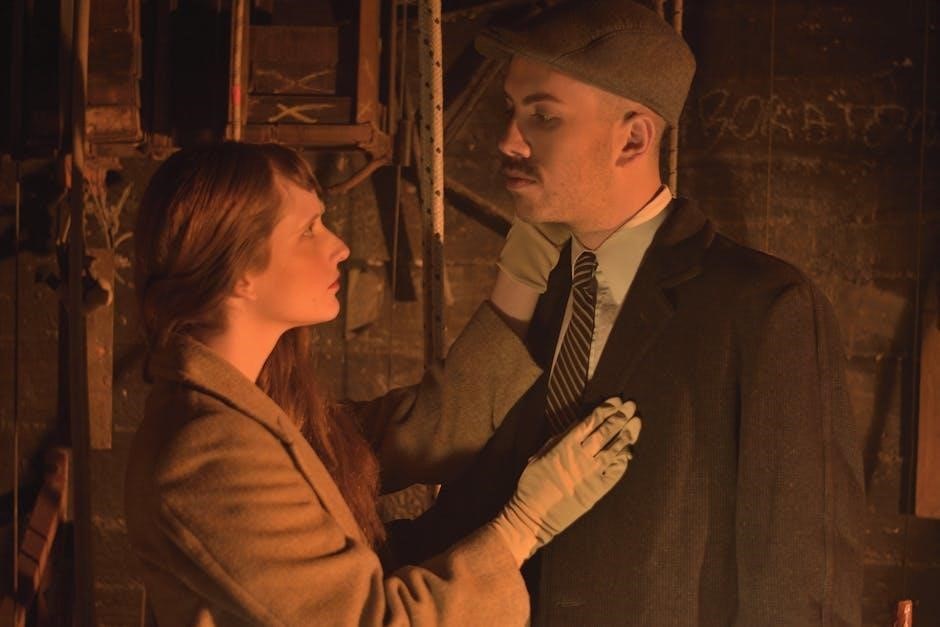
The ‘An Inspector Calls’ play PDF reveals a family disrupted by an investigation into a young woman’s suicide, exposing their interconnectedness and moral failings.
Act One: The Initial Investigation and Birling’s Self-Importance
Act One, readily available within an ‘An Inspector Calls’ play PDF, introduces the Birling family during a celebratory dinner. The arrival of Inspector Goole immediately disrupts this atmosphere of comfortable complacency. Mr. Birling, presented as a self-assured and somewhat pompous figure, dominates the initial conversation, expounding his views on social responsibility and the inevitability of peace.
The Inspector’s questioning begins with the suicide of Eva Smith, a young woman who tragically took her own life. Birling dismisses any personal responsibility, showcasing his capitalist mindset and belief in individual effort. He attempts to establish his social standing and influence, subtly hinting at his connections and potential to “deal” with the situation.
However, the Inspector’s persistent inquiries slowly begin to unravel Birling’s carefully constructed facade, hinting at a hidden connection between the family and the deceased woman; This act establishes the play’s central conflict and foreshadows the revelations to come, all accessible through the play’s PDF format.
Act Two: Unveiling the Connections to Eva Smith
Act Two, easily followed within an ‘An Inspector Calls’ play PDF, meticulously reveals the interconnectedness between the Birling family and Eva Smith (also known as Daisy Renton). The Inspector skillfully directs his questioning, exposing Sheila’s involvement first – her dismissal of Eva from Milwards, driven by petty jealousy. Sheila’s subsequent remorse marks a turning point, demonstrating a growing moral awareness.
The focus then shifts to Eric, whose drunken behaviour and exploitation of Eva are brought to light. He borrowed money from his father’s company to support her, a secret Birling vehemently attempts to conceal. This act highlights the abuse of power and the hypocrisy within the upper class.
Through the PDF’s text, we see the Inspector’s methodical approach, peeling back layers of deception and revealing the devastating consequences of their collective actions. Each revelation intensifies the family’s discomfort and guilt, building towards a dramatic climax.
Act Three: The Revelation and the Inspector’s Final Warning
Act Three, readily accessible when studying an ‘An Inspector Calls’ play PDF, delivers a shocking twist: the Inspector is not who he seems. Gerald’s inquiry reveals no Inspector Goole has been working at the local police station, leading the Birlings to believe it was a hoax. They attempt to revert to their previous self-assuredness, dismissing the events as a fabrication.
However, the arrival of a real police inspector, investigating the suicide of a young woman who matches Eva Smith’s description, shatters their complacency. This confirms the Inspector’s warnings were genuine and the Birlings’ actions had fatal consequences.
The play concludes with the Inspector’s powerful final speech, delivered through the PDF’s text, emphasizing social responsibility and the interconnectedness of humanity. He leaves them to grapple with their guilt, foreshadowing a future where such injustices may continue if lessons aren’t learned.

Resources and Further Study
Numerous online resources, including readily available ‘An Inspector Calls’ play PDFs, support deeper analysis. AQA specifications and critical essays enhance understanding.
Finding a ‘An Inspector Calls’ Play PDF Online
Locating a digital copy of J.B. Priestley’s ‘An Inspector Calls’ as a PDF is surprisingly straightforward, yet discerning quality is crucial. Many educational websites and online repositories offer downloadable versions, catering specifically to students preparing for AQA English Literature exams. However, be cautious of unofficial sources, as formatting errors or incomplete texts can hinder effective study.
Reliable platforms often provide PDFs aligned with the official syllabus, ensuring accurate page numbers for referencing during analysis and essay writing. Searching for “An Inspector Calls play PDF AQA” will yield targeted results. Remember to verify the source’s credibility before downloading to avoid potential malware or copyright infringements. Several online bookstores also offer legally purchased digital copies, guaranteeing a pristine and complete version of the play.
Consider utilizing school or library resources, as they frequently provide access to vetted digital texts. Always prioritize legitimate sources for the best learning experience.
AQA English Literature Specification and Assessment
The AQA English Literature specification dictates a thorough understanding of ‘An Inspector Calls’ for the Modern Texts section of Paper 2. Assessment focuses on students’ ability to analyze the play’s dramatic techniques, themes, and contextual influences. Utilizing a readily available ‘An Inspector Calls’ play PDF is invaluable for focused revision.
Students are expected to demonstrate knowledge of Priestley’s socialist views and the historical backdrop of 1912 Britain, connecting these elements to the play’s message. Exam questions typically require detailed textual analysis, demanding precise referencing – a PDF facilitates this. Familiarity with the AQA assessment objectives, including AO1 (articulate textual connections) and AO5 (demonstrate contextual understanding), is paramount.
Effective preparation involves practicing exam-style questions using the PDF text, honing analytical skills, and crafting well-supported arguments.
Critical Essays and Interpretations of the Play
Exploring critical essays and diverse interpretations of ‘An Inspector Calls’ enriches understanding beyond a surface-level reading. Accessing a ‘An Inspector Calls’ play PDF alongside these analyses allows for direct textual comparison, verifying arguments and forming independent judgements.
Scholarly articles often dissect Priestley’s dramatic techniques – the use of dramatic irony, symbolism, and the stagecraft employed to convey socialist messages. Examining these interpretations alongside the play’s text, readily available in PDF format, clarifies complex themes like social responsibility and class inequality.
Students benefit from understanding differing perspectives, strengthening analytical skills and preparing for nuanced essay responses. A PDF facilitates efficient cross-referencing, bolstering arguments with precise textual evidence.
Exam-Style Questions and Practice Responses
Utilizing a ‘An Inspector Calls’ play PDF is invaluable when tackling exam-style questions. Having the text readily available allows for quick referencing of key quotes and dramatic moments, crucial for constructing well-supported arguments.
Practice questions often focus on themes like social responsibility, the Birling family’s flaws, or the Inspector’s role as a moral catalyst. A digital PDF enables efficient searching for relevant passages, aiding in formulating concise and insightful responses.
Reviewing sample answers alongside the play’s text – accessible via PDF – demonstrates effective analytical techniques and strengthens understanding of assessment criteria. This combined approach maximizes exam preparation and boosts confidence.